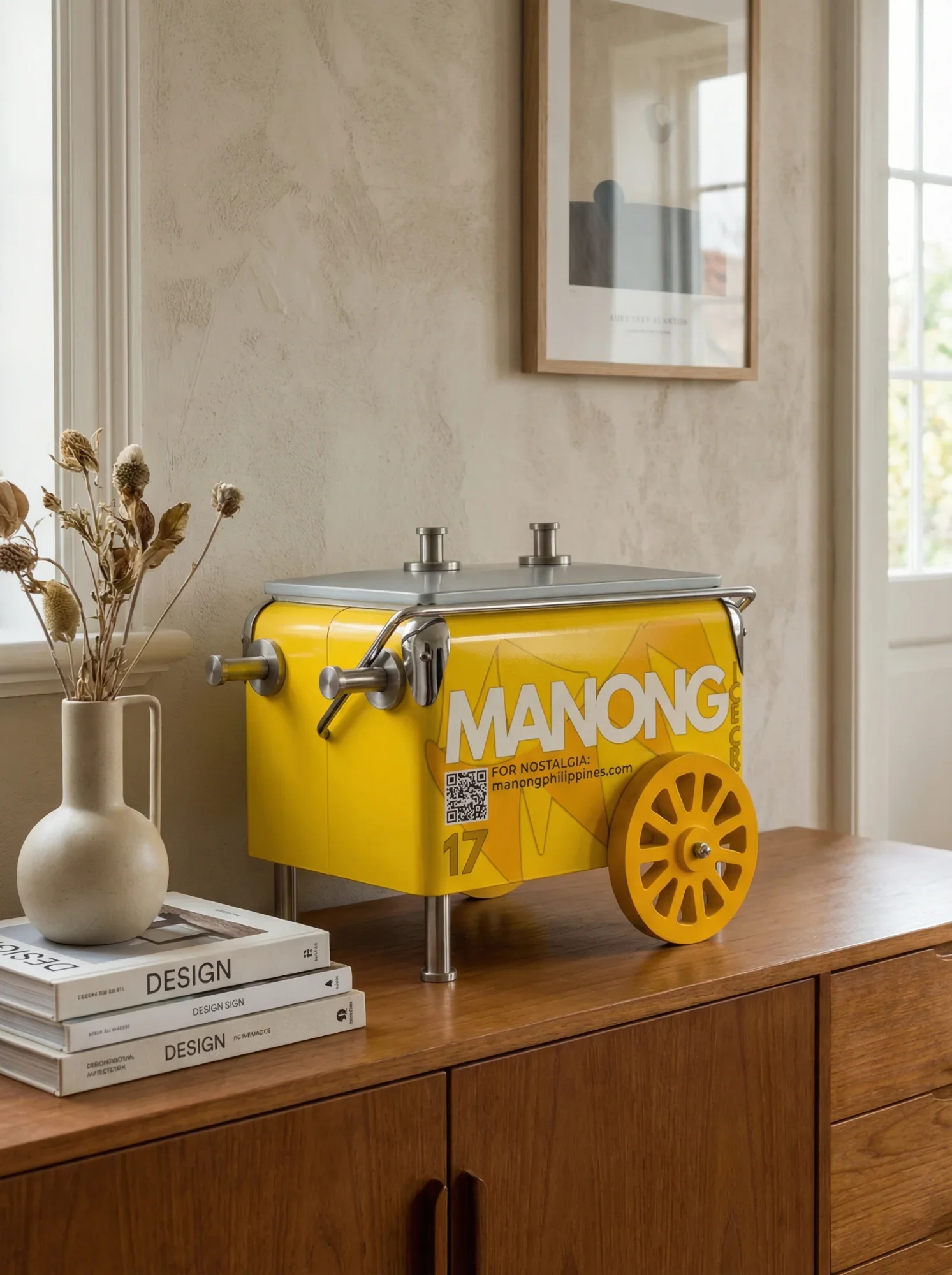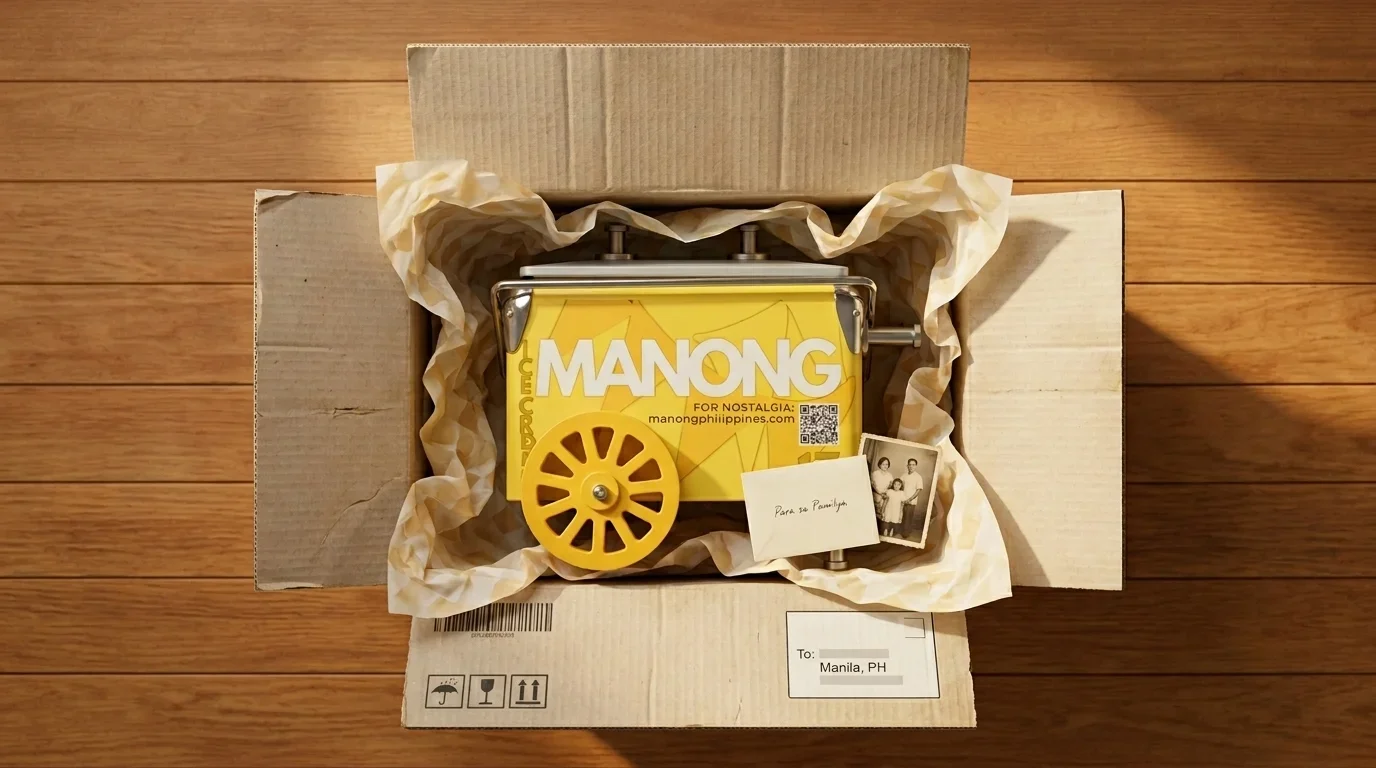
You don't see it first. You hear it.
A small bell, hand-rung, two or three times in the late afternoon heat. It travels through the neighborhood the way light travels through shuttered windows. Sideways, filtered, arriving before you expect it. Your body recognizes it before your mind does. Your feet are already moving toward the gate.
This is how sorbetes announces itself. Not with a sign. Not with a jingle. With a bell, and with everything the bell carries.
The Figure at the Gate
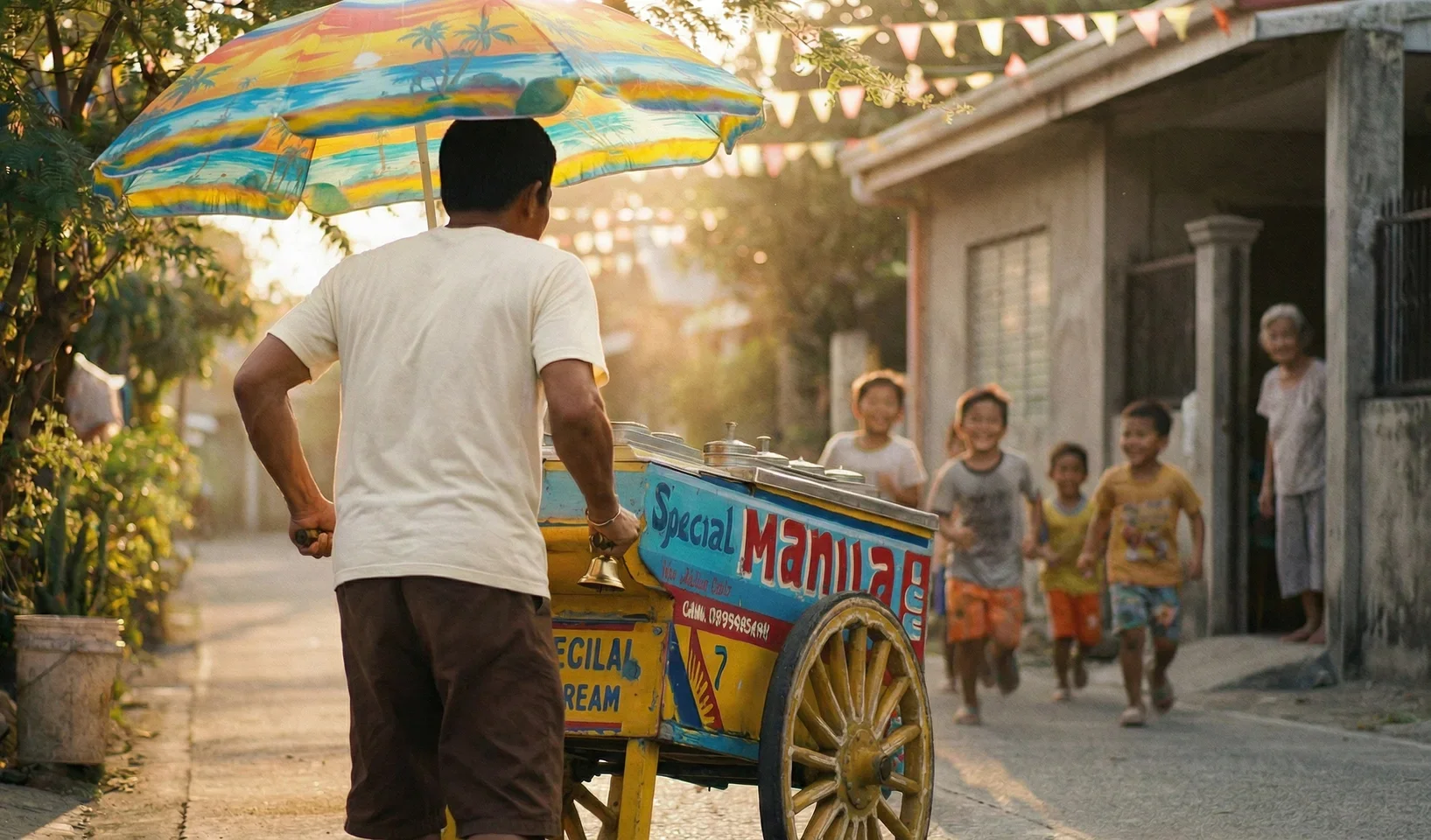
He came in the afternoons, usually. The manong sorbetero, pushing a wooden cart painted in whatever colors remained from some previous life. Faded blue, sun-bleached yellow, a red that had almost become pink. He wore a thin polo or a plain white undershirt. He was not young, mostly. He had the patience of someone who had been doing this a long time and expected to do it longer still.
He knew the neighborhood. He knew which streets had more children, which hours were slow, which mothers would wave him away and which would appear at the gate with a ten-peso coin before their children even asked. He was a fixture the way the corner sari-sari store was a fixture. Not remarkable until the day he stopped coming, and then suddenly, irreplaceable.
The cart was his whole economy. Inside it, packed in salt and ice, sat the garapinera. The metal canister that held everything. He'd park along the curb, ring the bell once more for good measure, and wait. And they came. They always came.
For the children growing up across the Philippine archipelago in the latter half of the twentieth century, the manong sorbetero was as much a character of childhood as any story they were told. He didn't sell ice cream so much as he sold a moment. A pause in the long, hot, ordinary afternoon.
Where It Began: Ice as a Luxury
The history of sorbetes in the Philippines begins, as so many Philippine stories do, with something arriving from somewhere else and becoming something entirely new.
Ice itself reached Manila in 1847, imported at considerable expense from New England by American merchant traders who had found a market for it in tropical ports. It was cargo, treated like cargo. Heavy, valuable, depleting. In the mid-nineteenth century, ice in Manila was a luxury reserved for the ilustrado class, for colonial administrators, for formal gatherings where its presence signified wealth. A piece of ice in a glass of water was a statement.
Frozen desserts followed. Spanish-influenced helados, dense and sweet and made with imported dairy, appeared in the homes of the elite and in the early establishments of Intramuros. They were served in proper glassware. They were not for the street.
Then the Americans arrived, and with them a different approach to commerce, infrastructure, and appetite. The American colonial period brought ice plants to Manila, then to Cebu, Iloilo, Davao. Ice became cheaper, more available, more democratic. And with cheaper ice came opportunity for those willing to push a cart through the heat and sell something cold.
The Philippine Adaptation
What the Filipino sorbetero made was not helado and not American ice cream. It was something that had no precedent because it had to account for what was actually available.
Dairy was expensive and scarce. But carabao milk, richer and fattier than cow's milk, was accessible in agricultural communities. Coconut milk was everywhere. Sugar from the sugarcane fields of the Visayas. Seasonal fruit: ripe mangoes, purple ube, young buko. These were not substitutes for the "real" ingredients. They were the real ingredients. The Filipino version of frozen dessert was built from what the islands actually produced.
The texture was different. Denser in some batches, softer in others. It melted faster in the heat, which imposed its own urgency on the eating. It tasted of place in a way that imported ice cream never could, because it was made of that place, from the soil and the milk and the fruit of it.
This was sorbetes. Not a Philippine version of something else. Something of its own.
The Garapinera and the Making
Before the commercial freezers, before the insulated carts with their foam lining and stainless steel, there was the garapinera.
The garapinera is a hand-crank freezing canister. A metal vessel set within a larger container packed with crushed ice and coarse salt. The salt lowers the freezing point of the ice, creating temperatures cold enough to freeze the mixture inside. The hand crank turns paddles that agitate the mixture as it freezes, keeping it smooth, breaking up ice crystals before they can grow large enough to make the texture grainy.
It is a process that takes patience. An hour, sometimes more. The person turning the crank turns it steadily, without stopping, without rushing, because the churning cannot be paused. It is a commitment made at the beginning and kept until the end.
Many sorbeteros prepared their batches before dawn or through the morning, then loaded the finished product into insulated containers in their cart, packed again in salt and ice, and set out in the early afternoon when the heat was at its most persuasive and the children had come home from school.
There was craft in this. Not the craft that gets documented and celebrated, but the craft of repetition. Of knowing by the resistance of the crank when the mixture was ready, of knowing by the texture and the smell when the ube was balanced or the mango needed more sugar. It was knowledge passed between people, adjusted by season and by what the market had that week.
The Name That Stuck
Outside the Philippines, the question sometimes arises: why do Filipinos call sorbetes "dirty ice cream"?
The name has nothing to do with hygiene and everything to do with mothers.
Filipino mothers, cautious about their children eating food prepared on the street, in the heat, from a cart that had been pushed through dusty roads, called it "marumi." Dirty. It was a warning, a discouragement, a maternal reflex toward safety that had its own logic, even if it never quite worked. The children ate the sorbetes anyway. The mothers sometimes did too.
The name migrated. It became the informal, affectionate term used even by those who loved sorbetes without reservation. "Dirty ice cream" became a marker of knowing, of being Filipino in a specific, childhood way. When Filipinos abroad use the phrase now, it carries no reproach. It carries a whole world.
The formal term, sorbetes, comes from the Spanish "sorbete," which itself comes from the Arabic "sharbat." The same root that gives English "sherbet." Languages move across oceans and leave traces. What they name becomes something the language didn't anticipate.
Ube, Mango, Cheese, Buko Pandan
The flavors are worth their own attention, because they are not arbitrary. Each one is a portrait of Filipino taste. A particular relationship between sweetness and place.
Ube, the purple yam, is the most iconic. Its color is unmistakable, a deep violet that looks almost artificial but is entirely natural, and its flavor is subtle. Earthy and sweet at the same time, nothing like vanilla but filling a similar role. Ube sorbetes stains the tongue faintly purple, which delighted children and vaguely alarmed their mothers.
Mango, when in season, was the obvious choice. The national fruit transformed into something cold and intensely itself, the ripeness concentrated. Cheese, a flavor that surprises people unfamiliar with Filipino dessert sensibility, works because Filipinos have long understood that salt makes sweet more interesting. The cheese flavor in sorbetes is mild, almost creamy, and it offsets the sweetness in a way that keeps you eating.
Buko pandan, made from young coconut and the vanilla-adjacent fragrance of pandan leaves, is a flavor that has no Western equivalent. It is cool and green-smelling and tropical in a way that connects directly to the experience of eating outside, under trees, in weather that makes you sweat.
Then there was the vessel. A thin wafer cone, crisp for about thirty seconds before the melting began, or, in the more adventurous arrangement, a small pandesal roll sliced open with the sorbetes scooped directly inside. The pandesal sandwich is a combination that sounds improbable and tastes entirely right. The slight saltiness of the bread, the soft crumb, the cold sweet ice cream meeting in the middle and requiring you to eat fast before they become one soft, collapsing thing.
The melting was always a race. This was understood. You didn't savor sorbetes the way you might savor something served in a cold room on a proper plate. You ate it in the sun, in the heat, with urgency, and the dripping down your hand was not a failure but a condition.
The Quieting Bell
The sorbetero is not gone. But he is rarer. In many neighborhoods where he was once a daily presence, he now appears only sometimes, on weekends, near schools, at the edges of markets and fiestas. In others, he has stopped coming entirely.
The reasons are practical and several. The cost of ingredients has risen. Ice and salt and the fuel to transport the cart have all become more expensive. The commercial ice cream industry, with its freezers and its supply chains and its presence in every convenience store, has competed for the same appetite with more capital and more consistency. Urban development has reorganized neighborhoods. The streets that once had children spilling out of houses in the afternoon now have traffic and time pressure and air-conditioned spaces that have no gates to wait by.
The manong sorbetero's livelihood depends on a particular kind of neighborhood life. Slow afternoons, children with time to stand at the gate, proximity and recognition. As that life has changed, the conditions for his existence have narrowed.
Some sorbeteros have adapted. Some have stopped. The ones who remain carry the weight of what they represent, not just a product but a way of time passing, a rhythm that once organized the late afternoon across the archipelago.
What the Bell Carried
A sound can hold an entire childhood. Neuroscientists have names for this: involuntary autobiographical memory, the olfactory-emotional pathway, the way sensory experience bypasses the thinking mind and lands directly in feeling. But you don't need the science to understand it. You just need to hear a hand bell two or three times in the afternoon heat and notice what happens in your chest.
What the bell of the sorbetes cart carried was not just the announcement of something cold and sweet. It was the announcement that the afternoon had a shape, that pleasure was available in small denominations, that the neighborhood knew you and you knew it, that childhood had its own economy of ten-peso coins and wafer cones and the brief companionship of other children standing at the same gate.
Sorbetes, in its full meaning, is not simply a dessert. It is the accumulated memory of a particular kind of Filipino life, unhurried, communal, enacted on the street rather than inside. It is the taste of place, made from the actual ingredients of the archipelago. It is the figure of the manong who learned which streets to take and which hours to appear, who built a living from patience and a hand-crank and the reliable desire of children for something cold.
When that bell rings less often, something specific becomes quieter in the world. Not dramatic. Not sudden. The way afternoons change when the children who once stood at the gate have grown and moved elsewhere, and the neighborhood takes on the particular silence of things that used to happen here.
This is not nostalgia as sentiment. It is nostalgia as knowledge. An understanding that certain things were good, that they shaped people in ways that cannot be fully articulated, and that their loss is real even when it arrives slowly and without announcement.
The bell rings. You remember everything. And then the afternoon is quiet again.