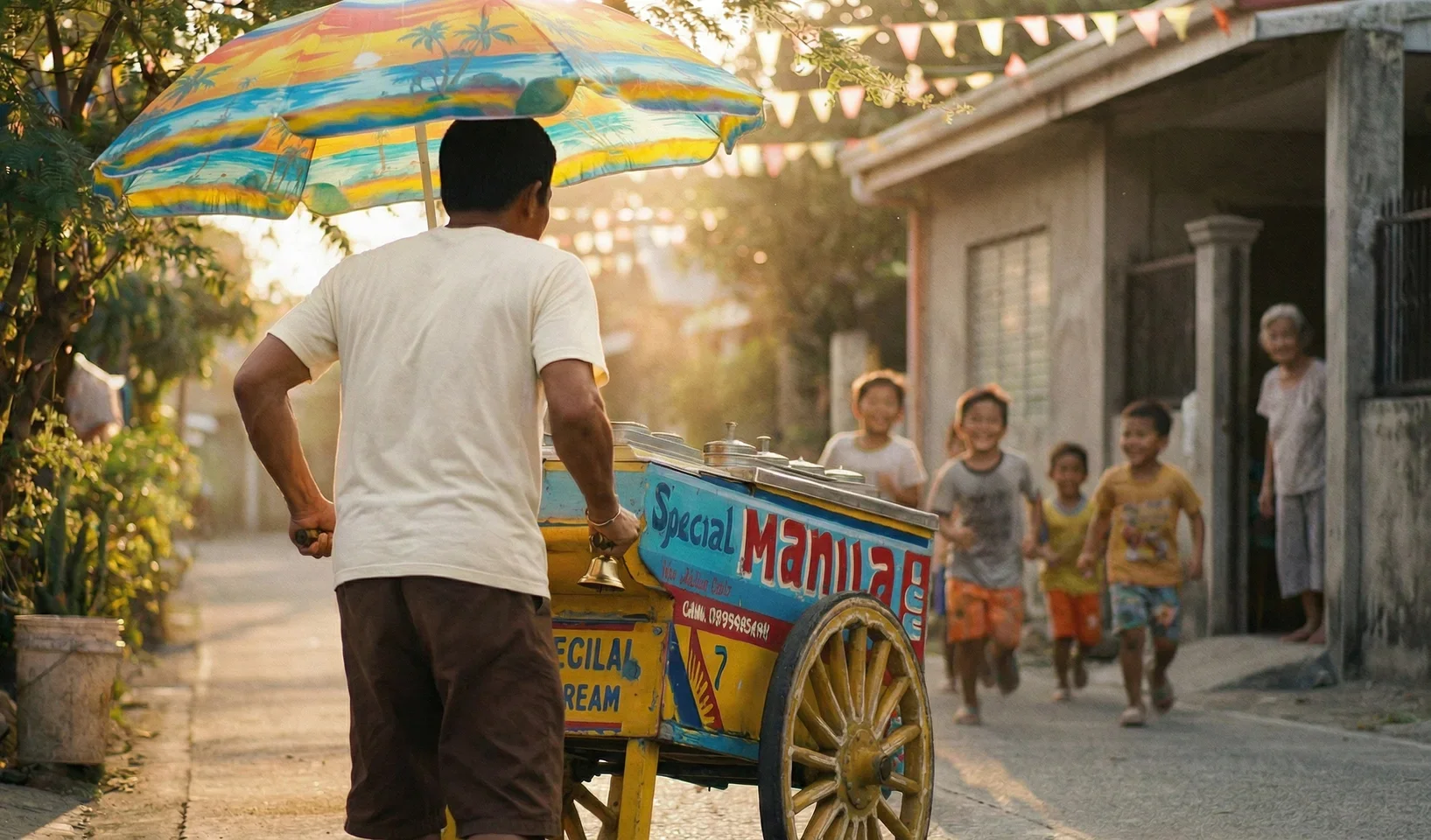
He is harder to find than he used to be.
In the older neighborhoods, Sampaloc, Paco, the quieter streets of Cebu and Iloilo, you can still hear him some mornings. The bell arrives before he does. A thin, metallic sound moving through the heat. Children know what it means without being told. They have always known.
But the manong sorbetero is disappearing from Philippine streets. Not dramatically. Not with any announcement. Quietly, the way most things worth grieving disappear. One neighborhood at a time, one generation at a time, until one day the bell does not come and no one can say exactly when it stopped.
A Memory with Nothing to Hold
There are 10.8 million Filipinos living outside the Philippines. They carry with them an archive of sensory memory. The smell of sampaguita. The weight of afternoon rain on a tin roof. The particular shade of sky just before a typhoon. And somewhere in that archive, for most of them, is the sorbetero.
The problem with memory is that it has no weight. You cannot set it on a shelf. You cannot pass it to someone who was not there. The sorbetero exists now mostly in the mind. A bell sound, a color, a taste that belongs to a specific afternoon in a specific childhood that no one else can enter.
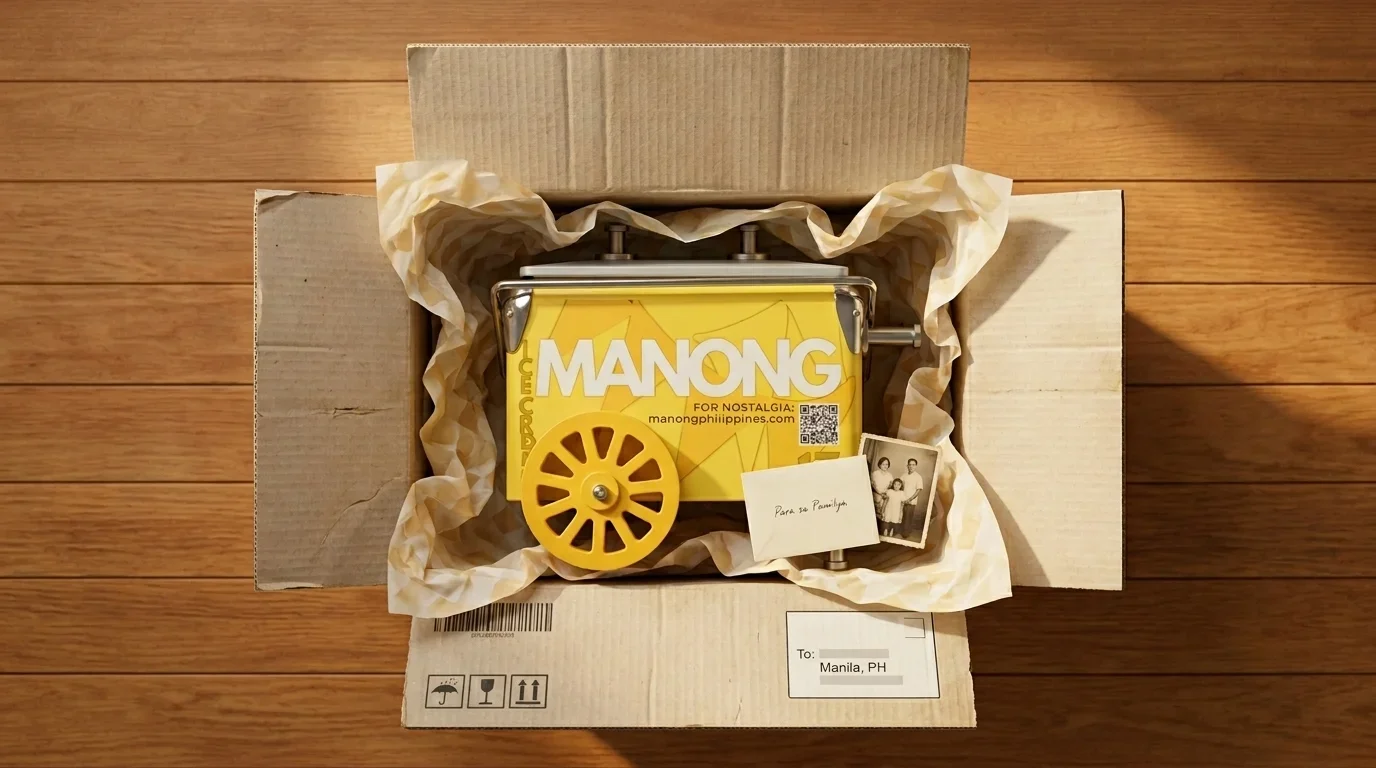
Objects change this. A photograph, a letter, a carefully made thing. These give memory a place to live outside the body. They make the intangible holdable. They allow a memory to be shared, even inherited, by someone who was never there at all.
For the Filipino diaspora, there is no shortage of longing. What has been missing is the object worthy of it.
The Question That Started Everything
What if someone made something you could keep?
Not a souvenir. Souvenirs are made for strangers, mass-produced, interchangeable, designed to be forgotten in a drawer. Not a trinket. Not the kind of thing that reduces a living culture to a caricature of itself. Something else. Something that preserved the figure the way he deserves to be preserved, with care, with detail, with dignity.
This was the question behind Manong Philippines. Not a business question. A cultural one. It asked what it looks like to take Filipino street memory seriously. To treat it not as raw material for nostalgia merchandise but as something worth the same attention a museum gives an artifact.
There is a particular coincidence in the founding of this brand worth noting. The surname of its founder is Manong. Not chosen. Not constructed for branding purposes. Simply true. The name of the figure being honored and the name of the person doing the honoring are the same word. Some things are hard to explain. Some things do not need to be.
Why Miniature
The decision to make the sorbetes cart in miniature was not a compromise. It was a philosophy.
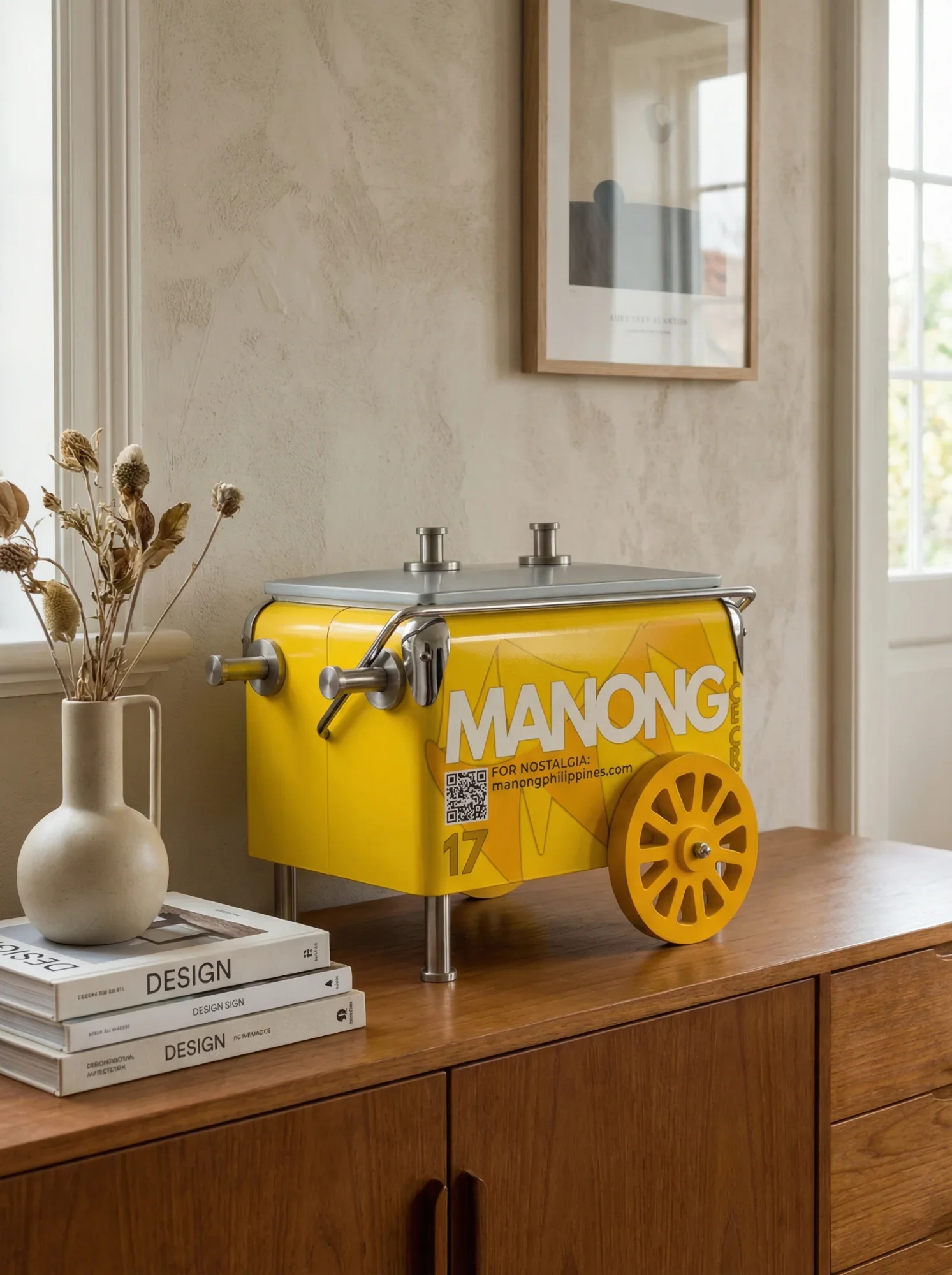
Memory is intimate. It does not arrive as a monument. It arrives small. In the particular way a bell sounds at a particular distance. In the blue and white paint on a cart you stood beside as a child. In the cold of a cylindrical container pressed against your palm. The miniature form honors this. It says that this thing is meant to be held, not displayed from a distance. It belongs in your hands first.
Every element of the Mini Sorbetes Cart was designed as an act of recognition. The bell. The proportions of the cart. The cylindrical containers and their colors. The wheel geometry. These are not decorative choices. They are the specific details that make a Filipino who grew up with the sorbetero look at the object and feel something land in the chest. That recognition is the product. The physical object is only its vessel.
This is why the design process began not with aesthetics but with accuracy. What did the cart actually look like? What did it carry? What were the colors used across different regions, different decades? The research was the work. The miniature is the result of that work, compressed into something you can hold in one hand.
A Broader Moment
Manong Philippines did not emerge in a cultural vacuum.
In Spring 2025, the USC Pacific Asia Museum mounted "Kultura ng Pilipinas," an exhibition exploring nostalgia, diaspora identity, and the objects Filipino communities carry across borders. The show asked what it means to maintain cultural memory when the original context no longer exists. When the streets change, when the vendors disappear, when the next generation is born somewhere else entirely.
The "Batang 90s" movement in the Philippines has spent years documenting and celebrating the material culture of a generation. The jeepney designs, the snack brands, the street vendors who shaped daily life before the country accelerated into something else. This is not sentimentality for its own sake. It is the work of a culture deciding what it wants to remember about itself.
Globally, more than 70 percent of adults actively seek out heritage products, objects connected to cultural identity, family memory, or a sense of continuity with the past. This is not nostalgia as weakness. It is nostalgia as orientation. A way of knowing where you come from so you can understand where you are.
Manong Philippines enters this conversation not as a trend-follower. The brand did not read a market report and identify an opportunity. It began with a genuine question about loss and preservation, and the cultural moment arrived to meet it. These are different things, and the difference matters.
What This Brand Is Not
It is not a souvenir shop. Souvenir shops sell objects that say "I was here." Manong Philippines makes objects that say "I remember."
It is not a novelty brand. Novelty is designed to surprise briefly and then be forgotten. The Mini Sorbetes Cart is designed to be kept, to sit on a desk, a shelf, a windowsill, and to mean something different six months after you acquire it than it did the day it arrived.
It is not riding a wave. The nostalgia economy is real, and the Batang 90s moment is real, and the diaspora market is real. But the existence of a wave does not mean every surfer belongs on it. Some things exist because someone identified a trend. Some things exist because something real is being lost and someone decided to preserve it. Those are not the same origin, and they do not produce the same objects.
This brand is a Filipino heritage brand in the most literal sense, not as a marketing category, but as a description of function. It preserves heritage. That is the whole of it.
What This Brand Is
It is a quiet act of cultural preservation.
The sorbetero is not famous. He is not a national symbol in any official sense. He does not appear on currency or in history textbooks. He belongs to the street, to the ordinary afternoon, to the part of Filipino life that has always existed between the monuments. This is precisely why he is worth preserving. The extraordinary is already preserved. It is the ordinary that disappears without record.
The Mini Sorbetes Cart is a sorbetes collectible in the same way a museum piece is a collectible, not because it is rare or expensive, but because it holds something that would otherwise be lost. It is a Filipino nostalgia collectible that takes its responsibility seriously. It asks to be cared for. It asks to be understood. It is not designed to be bought and forgotten.
Filipino cultural preservation, at its most honest, is not the work of institutions alone. It is the work of anyone who decides that something worth remembering deserves an object worthy of the memory. Manong Philippines made that decision about the sorbetero. The Mini Sorbetes Cart is the result of that decision, made physical.
Heritage, not novelty. Nostalgia, not kitsch. Culture, not trend.
The Last Sound
The manong sorbetero will keep disappearing. This is the reality. Streets change, economics shift, cities grow in directions that leave no room for a man with a cart and a bell. The Philippines of the next generation will be different from the one that exists today, which is already different from the one that shaped the memory of every Filipino now living abroad.
This is not tragedy. This is time. Every culture changes. What a culture chooses to remember, and how carefully it chooses to remember it, says something true about what it values.
The Mini Sorbetes Cart does not stop anything from disappearing. It does not claim to. It only says that this figure, this ordinary man on an ordinary street on an ordinary afternoon, deserved to be kept.
Some memories are worth holding onto. Some things are worth making well enough to last.
A memory worth keeping.